



Symmetrical Internet: What It Is & When You Need It Most
Upload speed is just as important as your download speed. For business users, remote workforces, or content creators online, the concept of an internet connection moving data both ways at the same rate makes all the difference.
This is the power of symmetrical internet: real high-speed broadband that can handle as much upstream traffic as downstream. If upload bottlenecks or collaboration gaps are a problem for your team, or your online content pipeline is failing to keep up with delivery speeds, in this article we’ll help you consider why symmetrical internet service might be right for you.
What Is Symmetrical Internet?
Put simply, symmetrical internet means your upload speed is equal to your download speed. A 300/300 Mbps symmetrical connection, for instance, would upload at the same rate as it downloads.
Compare this to “asymmetrical” broadband plans where the upload speed is slower than the download speed. This might be 300 Mbps download/10 Mbps upload, or 200/20, 100/10 and so on for a standard residential connection.
For many modern workloads, cloud workflows, and video conferencing performance, the upload performance gap between symmetrical vs. asymmetrical internet service can have a significant impact on productivity, connectivity, and efficiency. This is especially true for content creators, live streamers, and remote teams that collaborate in real-time, where faster upload speeds impact video quality, file transfer times, and the overall responsiveness of collaboration tools. Low latency connections also mean video calls and creative apps are far more fluid, with less lag or drop-offs even during periods of high traffic.

Why Most Symmetrical Plans are Fiber
Many symmetrical plans are fiber internet (FTTH) because, by design, fiber can push high-speed data traffic both upstream and downstream without degradation.
Cable and DSL broadband were built to be asymmetrical, and most business-grade alternatives like dedicated internet access (DIA) or fixed wireless access (FWA) are not symmetrical at every location.
It is possible to receive symmetrical service using a DIA circuit and even some FWA services where line of sight and provider network architecture allow.
Symptoms You’re Ready for Symmetrical Speeds
Most small businesses won’t know they “need” symmetrical internet until they experience an event that illuminates an upstream bandwidth bottleneck. Whether it’s slow cloud uploads, VoIP quality issues, content publishing lags, or friction in day-to-day operations, here are some indicators to look for:
Business indicators:
- Frequent call drops using Zoom, Teams, or Webex
- Slow cloud uploads to M365, Google Drive, Box, or Salesforce
- Simultaneous collaboration across multiple offices
- Remote work/home office complaints about connectivity
- Poor signal on VoIP phone calls
- Livestreaming, content production, or other upload-heavy activities
Home with high-speed needs:
- Twitch and YouTube regular content creators
- Uploading from home cameras: dash cams, security, or nanny cams
- Syncing large media projects to online storage
- Serving shared WiFi to many concurrent users
If your operations or home network live and die by real-time communications, constant uploading, or content generation, upgrading to symmetrical internet speeds can give you smoother, more predictable, and more resilient performance with low latency.
Benefits That Actually Move the Needle
In the world of sales pitches and internet “buzzwords,” claims about symmetrical speeds can often outpace reality. However, in high-upload-use cases, moving to a symmetrical plan has some real, concrete, and productivity-driven advantages:
- Real-time quality: Calls, video meetings, and live events (video calls, gaming, music performance) stay stable even as more users or clients join, thanks to consistent upstream performance.
- Reduced jitter and packet loss: Asymmetrical connections may throttle upstream speeds as upload-heavy applications compete for bandwidth. VoIP calls, cloud-based video meetings, audio conferencing, or digital stream viewership can be negatively impacted, with lost packets leading to choppy audio/video and frustrating jitter.
- Faster cloud workflows: Upload large files, push code commits, or sync your digital asset management (MAM/DAM) repository faster, allowing work to complete during business hours instead of overnight.
- Network-wide capacity: Symmetrical connections provide enough bandwidth so that one user’s uploads don’t saturate the line, maintaining predictable throughput for all users and devices.
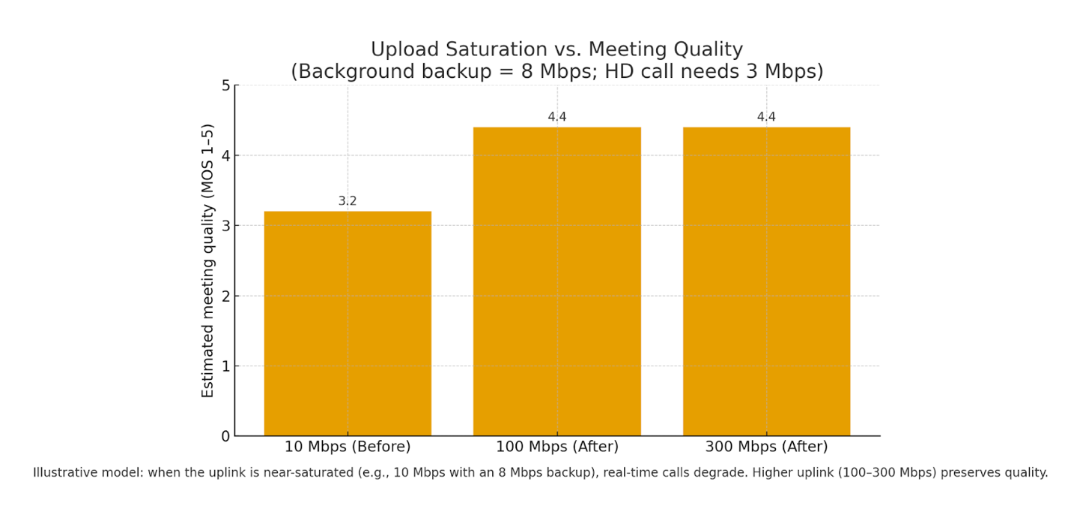
To sum up, removing upstream bottlenecks has a direct, tangible impact on both team efficiency and user experience.
Symmetrical vs. Asymmetrical: Which Is Right for You?
Symmetrical and asymmetrical internet are two sides of the same coin, so choosing between the two comes down to understanding your unique needs:
- Asymmetrical internet is fine for individual browsing, streaming video, or if all you do is download large files. Faster uploads still help, but they’re not essential for critical operations. For instance, a home user who primarily streams Netflix or browses websites may not notice the difference. In contrast, a marketing team uploading daily video campaigns, a remote office collaborating on large CAD files, or a podcaster streaming high-quality audio will see immediate productivity gains from symmetrical internet.
- Symmetrical internet is critical when you need fast uploads for two-way communications, frequent large-file uploads to the cloud, content creation, or publishing workloads, or if you’re operating in a multi-user environment where everyone is uploading constantly.
For businesses running Unified Communications as a Service (UCaaS) solutions, frequent cloud backups, or livestreaming events, symmetrical internet is often the only way to avoid painful interruptions and common user frustrations.
Total Cost of “Slow”
If uploads are slow, operations slow down with them, which costs time and money. This means:
- Lost time in support calls
- Slipped cloud upload deadlines (project or client deliverables)
- Slower team or remote office collaboration
Positioning symmetrical internet speeds as a productivity and team-efficiency safeguard can reframe the conversation from “cost center” to “investment.”
What If Fiber Isn’t at Your Address?
In many markets, mass-market fiber internet is pervasive and can be the fastest path to symmetrical speeds. However, not every office or home has access to it. If fiber isn’t an option, consider alternatives.
Dedicated Internet Access (DIA) & SLAs
Dedicated Internet Access is a business-grade service that can provide a high-performance symmetrical connection:
- Guaranteed bandwidth, without “up to” overstatements
- Minimal over-subscription to the network
- Service level agreements (SLA) covering uptime, latency, packet loss, and time to repair

A strong SLA ensures that businesses and content creators can maintain consistent multi-gig internet speeds for critical uploads, video conferencing, or live event streaming. Guaranteed uptime and quick response times minimize workflow interruptions, protecting both productivity and client deliverables.
Even in a non-fiber building, it’s often possible to obtain a symmetrical DIA connection for upload-intensive workloads. Learn more about DIA here.
Fixed Wireless as a Bridge
Some providers offer fixed wireless access (FWA) capable of symmetrical service. Performance depends on line-of-sight, local provider network architecture, and antenna installation. FWA can serve as an interim solution while waiting for fiber or as a permanent option where fiber isn’t planned.
Optimize What You Have (Quick Wins)
If you’re already on an internet connection, there are steps to improve upload performance:
- Enable network QoS (quality of service) for upload-sensitive applications (VoIP, live streaming, online meetings)
- Segment guest/IoT traffic from main users
- Schedule backups and bandwidth-heavy tasks for off-peak hours
- Confirm your modem/router supports your speed plan or upgrade as needed
Small changes can help ease upstream congestion and optimize current performance. For instance, prioritizing video conferencing traffic over background cloud backups or large file uploads can make a dramatic difference for remote teams. Content creators may schedule massive video exports during off-peak hours, ensuring that live streams or collaborative editing sessions remain smooth.
How to Choose a Symmetrical Plan the Smart Way
Getting a symmetrical plan is just the first step. Selecting the right one requires planning, testing, and user engagement.
Map Workloads to Upstream Needs
Define upstream needs for your operations now and in the future:
- Smaller teams using UCaaS: 50–100 Mbps upload
- Content creators, podcasters, streamers: 100–300 Mbps upload
- SMBs with regular cloud backups or heavy SaaS usage: 50–200 Mbps per office
Use ranges rather than fixed numbers to accommodate peaks and multi-user environments.
Vet the Offer
Ask these questions before signing a plan:
- Is bandwidth guaranteed or “up to”?
- What are the over-subscription levels?
- Are there traffic-shaping policies?
- How robust is peering with cloud providers (AWS, Google, Microsoft)?
- Are SLA terms (uptime, latency, packet loss, repair times) acceptable?
Learn more about SLAs here.
Equipment and WiFi Considerations
Even the fastest plan won’t perform if the network equipment can’t handle it:
- Switches and routers must support multi-gig internet speeds
- WiFi bands should be allocated to handle peak traffic efficiently
- Connected devices shouldn’t bottleneck your plan
Proper equipment ensures you fully leverage your symmetrical internet connection.
ROI Snapshot: When Symmetrical Pays for Itself
One of the clearest ways to justify symmetrical service is to show the financial impact of faster uploads.
A Simple Time-Savings Calculator
Picture this: A team spends 15 hours/week uploading large files at 10 Mbps. Moving to 200 Mbps reduces that to 1 hour. With a team average of $50/hour, the weekly ROI is $700, or nearly $3,000/month for a small team.
Symmetrical internet can turn wasted hours into productive time, with real impact on your bottom line.
Implementation Plan
Deploying symmetrical internet requires thoughtful planning:
Check Availability
Search for fiber or DIA options, confirm construction timelines, and evaluate alternatives. DIA and FWA are credible options if fiber isn’t available.
Pilot and Measure
Run a two-week trial to measure latency, jitter, packet loss, and call MOS scores before and after implementation to ensure the connection performs as expected.
Train & Tune
Educate users on heavy-upload etiquette, update QoS rules, and schedule backups. Proper training ensures your symmetrical connection performs optimally.
Investing in symmetrical internet is about reliability, scalability, and future-proofing your network. As workflows become increasingly cloud-centric and collaborative, consistent upload performance ensures your team stays productive, your content reaches audiences quickly, and your operations remain uninterrupted.
FAQs
Do I need symmetrical internet for gaming/streaming?
Download speed matters more for casual gaming. Symmetrical speeds help mainly for livestreaming or content creation.
Is symmetrical internet always fiber?
Most mass-market symmetrical internet is fiber. Business-grade alternatives like DIA or FWA can also deliver symmetrical service.
What else impacts my experience besides speed?
Latency, jitter, packet loss, WiFi quality, and ISP-to-cloud peering arrangements also affect real-world performance.
Why should I consider multi-gig internet if my current plan seems fast enough?
Multi-gig internet provides extra headroom for multiple users, high-volume uploads, and low-latency tasks. For content creators or businesses running cloud-heavy workflows, the higher capacity reduces the risk of bottlenecks and ensures consistent video conferencing performance even during peak hours.
Symmetrical internet used to be a “nice to have” or “premium” service. But for teams and creators that need consistent upload speed, high-quality VoIP call quality, reliable cloud backup speed, and smooth live streaming upload, symmetrical service is now the standard.
Whether you’re exploring fiber internet, DIA, or FWA as alternatives, ensure your equipment and network design aren’t bottlenecks. The right symmetrical plan can reclaim hours of productivity, improve remote work connectivity, and enhance overall network performance.
For more information on business-grade internet options, check out 24-7 & West Wisconsin Telcom business internet plans and networking solutions.